
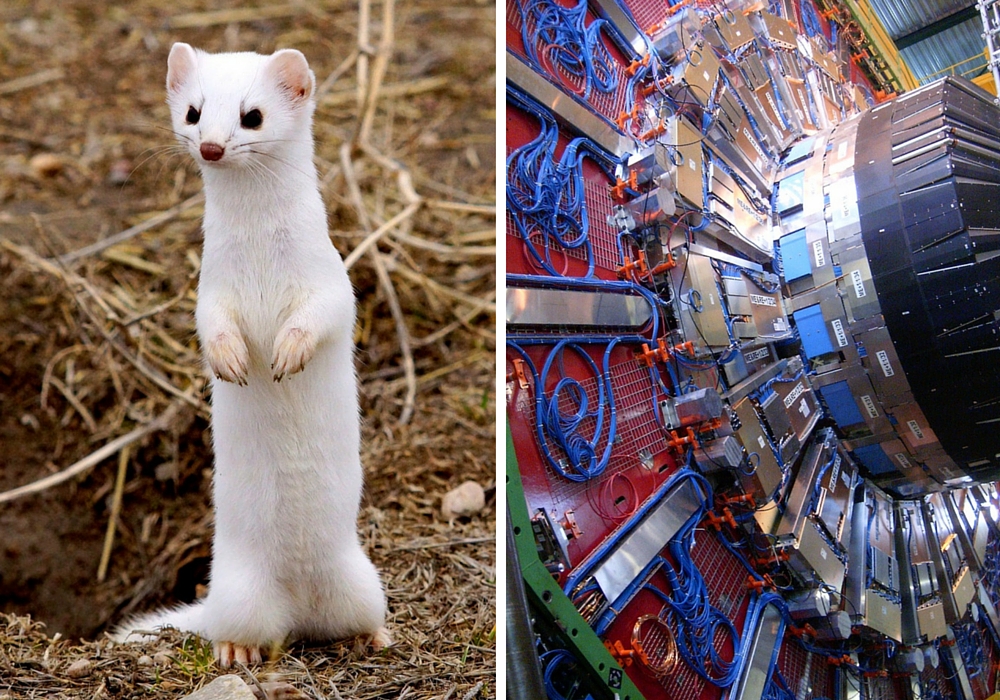
A weasel caused the Large Hadron Collider at CERN to shut down
Wiki Commons
The CERN Large Hadron
Collider particle accelerator has been temporarily shut down after a
weasel caused a "severe electrical perturbation" in the early hours of
Friday ( 29 April) morning. The LHC at the European Organisation for
Nuclear Research (CERN) near Geneva, in Switzerland, is currently
offline after a short circuit, caused by the tiny predator.
Unfortunately the weasel died after colliding with a
high-voltage transformer and it is thought that it may take a few days
to repair the damage. According to CERN, the intrepid animal did not
gain access to the huge tunnels where particles have been smashed
together to replicate the 'Big Bang' - just the electrical facilities.
The LHC consists of a 27-kilometre (17 mile) ring of
superconducting magnets, with a number of accelerating structures to
boost the energy of the particles. It cost an estimated $13.2bn (£9bn)
and is the world's biggest science experiment, best known for
discovering the Higgs Boson, or 'God particle'.
The site is positioned in the Swiss countryside surrounded
by wildlife. In 2009, the LHC was shut down by what they believe was a
bird, although no remains were found. CERN's report of the latest
incident says that the weasel got into a 66kV transformer and as a
result, the transformer connections were damaged.
The LHC went through an extensive upgrade between 2013 and 2015 and is now said to be more powerful than ever.
In February 2016, CERN's Large Hadron Collider managed to
recreate the beginning of the universe
, and therefore observe quarks and gluons in the brief moments following the Big Bang.
In July 2015, CERN's Large Hadron Collider discovered a pentaquark.
And earlier this month
CERN
released over 300TB of data from the LHC onto the internet for free to
enable anyone to study particle physics and use the data in their own
research.
The data is available on the CERN Open Data Portal,
which was developed by CERN's IT Department and Scientific Information
Service in collaboration with the researchers running the Compact Muon
Solenoid (CMS) general-purpose particle physics detector at the LHC.
Post a Comment