Articles by "Web Browsers"


The healthcare sector has had its problems in terms of cyber-security, and according to US firm Duo Security, some bad technological habits may have something to do with it.
The company compared statistics from its long list of clients from various sectors and noticed a series of oddities that can explain why healthcare organizations are currently facing data breaches and ransomware infections on a daily basis.
The statistic that stood out was the usage of Flash and Java in healthcare organizations. While in other sectors Flash was installed on 25 percent of all devices, in healthcare organizations Flash was found on 52 percent of all computers. The same discrepancy was noticed in Java usage, with regular industries deploying it on 12 percent of its PCs, while the healthcare sector was using it on 36 percent of computers.
Both Flash and Java are the favorite targets of exploit kits, who often update their crimeware kits within days after a Flash or Java flaw becomes public.
Internet Explorer? Really?
But the oddities didn't stop here, and Duo Security researchers also observed that most healthcare organizations are running Internet Explorer 11 than they are running the most recent versions of Google Chrome. In fact, IE 11 was found running on 33 percent of healthcare organizations' PCs, while Chrome 48 only on 28 percent of computers.
Breaking down IE usage overall, Duo Security experts also noticed that out of all the Internet Explorer browsers running in the healthcare sector, 22 percent of users were using an outdated version, compared to the six percent seen in other industries.
You can still find a lot of hospitals and clinics running good ol' XP
The whole healthcare sector has an unquenchable love for Microsoft products overall, with 82 percent of all devices running a Windows OS.
While Microsoft released Windows 10 last summer, offering it as a free upgrade to all Windows 7 and 8 users, only ten percent of healthcare computers are running this OS version today, compared to the 15 percent in other industries.
Even worse, three percent of healthcare organizations are still running XP, a Windows version that Microsoft officially retired in 2014. The Royal Melbourne Hospital ran Windows XP computers until this past January when a malware infection brought the hospital operations to its knees.
Using XP, and for that matter, even Windows 7, is a dangerous endeavor. With XP reaching end of life and Windows 7 on its last leg, its time for healthcare organizations to start moving their PCs to more modern-day OS distributions.
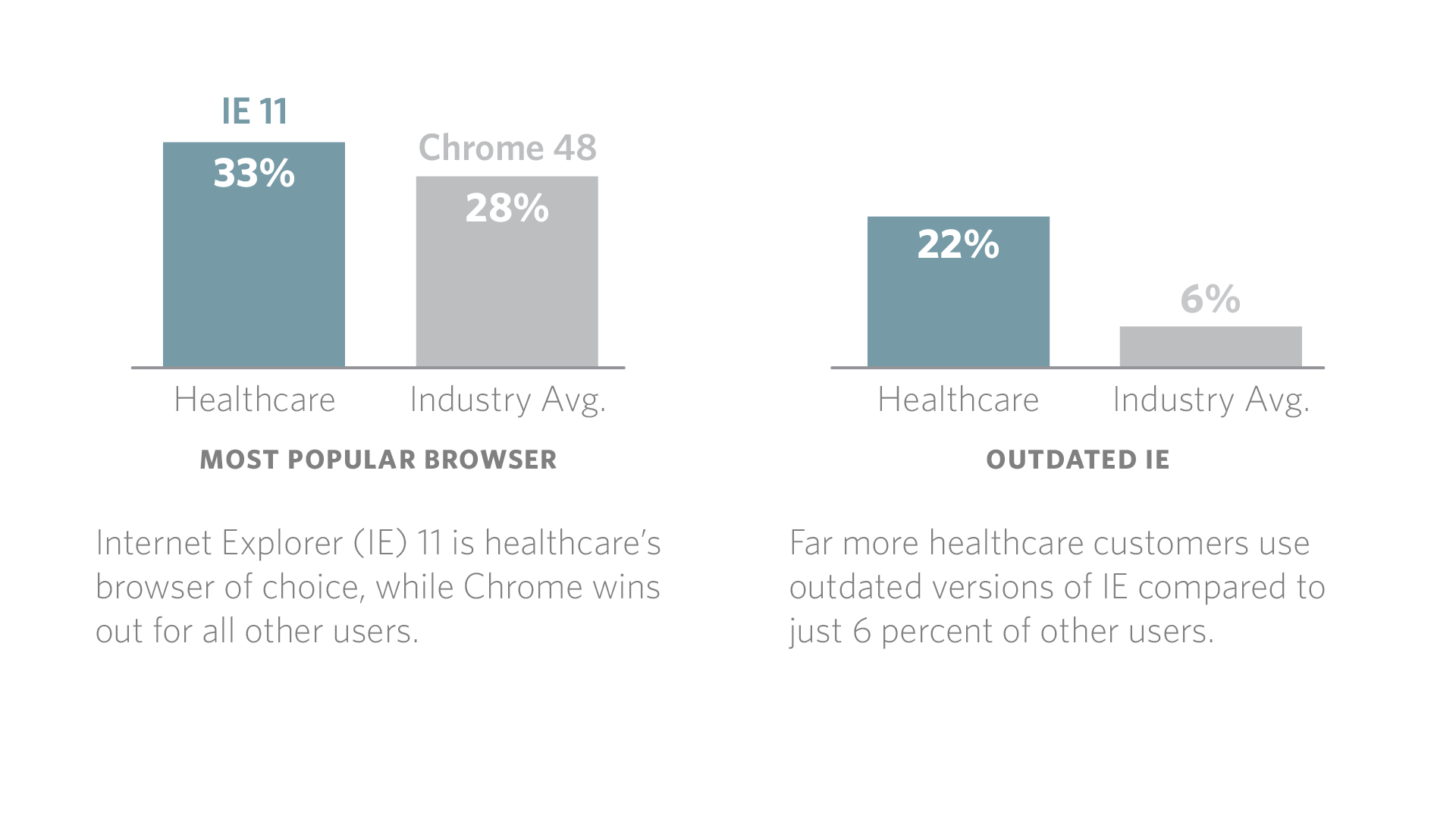
Browser usage in healthcare sector

Ubuntu users will finally have 0-day releases of Firefox

Marius Nestor
Mozilla today, April 21, 2016, announced the availability of future releases of their popular Firefox web browser in the snap package format for Ubuntu 16.04 LTS.
Earlier today, Canonical unleashed the final release of the highly anticipated Ubuntu 16.04 LTS (Xenial Xerus) operating system, bringing users a great set of new features and improvements, among which support for installing packages in the snap format used until now only on the Snappy Ubuntu Core OS for embedded and IoT devices.
Also today, it looks like Canonical has renewed their partnership with Mozilla to offer Firefox as the default web browser for Ubuntu 16.04 LTS and upcoming releases of the Linux kernel-based operating systems. As part of the new partnership, Mozilla is committed to distributing future versions of Firefox as a snap package.
"Today, Mozilla and Canonical are renewing their partnership to make Firefox the default browser for Ubuntu users. We are proud to have been a partner of choice for Ubuntu for over a decade," said Nick Nguyen, vice president of Firefox Product, Mozilla. "Canonical and Mozilla share a similar heritage as open-source and community-supported organizations."
What does this mean for the regular Ubuntu user?
Canonical always offered the latest version of the Mozilla Firefox web browser on supported Ubuntu Linux operating systems after only a couple of days from the upstream release; sometimes even on the same day, but rarely. Having Firefox distributed in the snap format means that you'll have 0-day releases in Ubuntu 16.04.
Yes, just like Windows and Mac OS X, users are enjoying their 0-day releases of Mozilla Firefox and don't have to wait for package maintainers of a particular GNU/Linux distribution to update the software in the main repositories. For Mozilla, having Firefox as a snap package means that they'll be able to continually optimize it for Ubuntu.
"Like our rapid engineering release cycle, snap format will allow us to provide Linux users the most up-to-date features, in particular security patches, even after major Operating System ship dates," said Nick Nguyen. "With the snap format, new features can be released to users of older OS versions too."
When will Firefox be available as a snap format for Ubuntu?
According to Mozilla, it looks like the first ever version of the Firefox browser to be offered as a snap package for Ubuntu Linux will be available later this year. Of course, Mozilla will still offer Firefox as 64-bit and 32-bit binaries, as well as a source archive for users of other GNU/Linux operating systems.
The current version of the Mozilla Firefox web browser available in Ubuntu 16.04 LTS (Xenial Xerus) and other Linux kernel-based operating systems is 45.0.2, and looking at the official release schedule, the next major version, Firefox 46.0, will ship next week, on Monday, April 26, 2016.

Afrogalaxy

Contact Form

Name

Email *

Message *

Powered by Blogger.
Javascript DisablePlease Enable Javascript To See All Widget